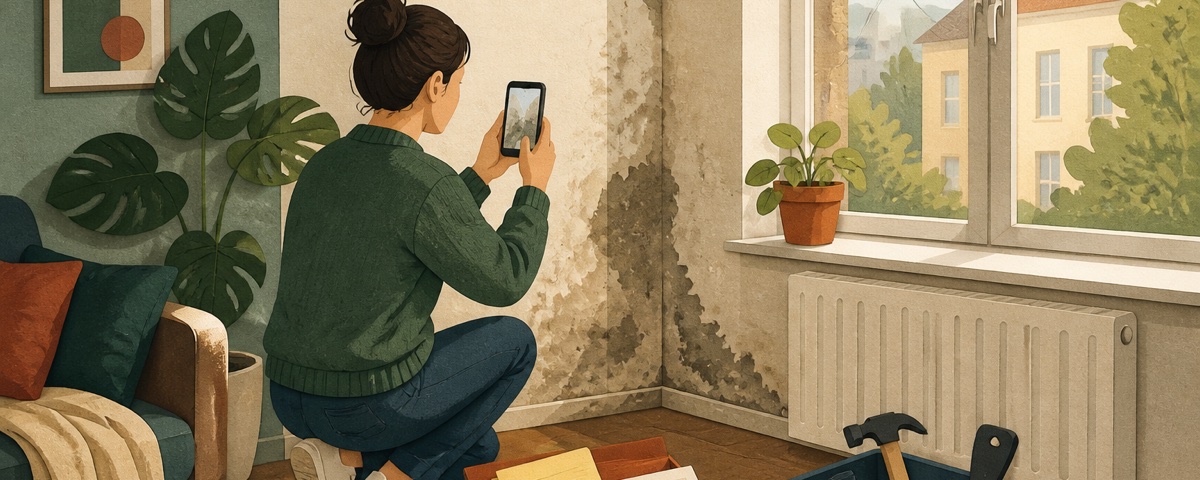
A home that costs you €700 a month but whose heating never exceeds 16°C in January, where mold creeps up the bedroom walls, and whose living space barely reaches 8.5 m². You're not just being "picky." You may be in an unfit dwelling, and the law protects you.
The problem is that many tenants confuse discomfort with unfitness. An ugly, poorly insulated, or noisy home is not necessarily unfit in the legal sense. However, a home that fails to meet the criteria of the decree of January 30, 2002 is, and the landlord has an obligation to bring it into compliance.
You still need to know how to prove unfitness and not be lulled by a landlord who has been promising repairs "soon" for eighteen months.
The 30-Second Answer
A dwelling is unfit if it fails to meet the minimum standards set by Decree No. 2002-120 of January 30, 2002: a living area of at least 9 m², sufficient ceiling height, no risk to safety or health, essential amenities in working order, no leaks or excessive dampness, and adequate heating.
If your dwelling is unfit, you must first send a formal notice to the landlord by registered letter with return receipt. If they don't respond, you can refer the matter to the departmental conciliation commission, then to the judge of the protection litigation court. The judge can order repairs, reduce the rent, or suspend its payment, and award damages.
Think your lease contains clauses that make things worse? Before starting proceedings, check what your contract actually says.
What the Law Says
Article 6 of the law of July 6, 1989 requires the landlord to provide the tenant with a decent dwelling. This obligation is non-negotiable: no lease clause can waive it. The landlord must deliver a dwelling that poses no obvious risks to physical safety or health and is equipped with elements making it suitable for residential use.
Decree No. 2002-120 of January 30, 2002 specifies the criteria. They are cumulative: a single breach is enough to establish unfitness.
The Decency Criteria in Detail
Surface area and volume. The dwelling must have a living area of at least 9 m² and a ceiling height of at least 2.20 meters, or a living volume of at least 20 m³. Living area is understood as defined in Article R. 111-2 of the Construction and Housing Code: walls, partitions, steps, stairwells, door and window recesses, and areas with a height of less than 1.80 meters are excluded.
Safety and health. The dwelling must provide shelter and cover: walls, floors, ceilings, and roofs must not present a risk of collapse or let in water. Electrical, gas, and heating installations must comply with safety standards. Openings to the outside must be airtight and watertight. The dwelling must not be infested with parasites or pests.
Essential amenities. The dwelling must include:
- a potable water supply installation;
- a wastewater drainage installation;
- a heating system suited to the dwelling's characteristics;
- an electrical installation providing normal lighting;
- a kitchen area with a sink connected to hot and cold water and a cooking device;
- sanitary facilities including at least one toilet, whether separate from the bathroom or not, and a bathtub or shower.
Dampness and ventilation. The dwelling must not show water infiltration, rising damp, mold, or excessive condensation. Adequate ventilation must be possible.
Energy performance. Since the Climate and Resilience Law, a dwelling is also considered unfit if it is rated G on the energy performance diagnostic (DPE) for leases concluded, renewed, or extended from January 1, 2025, and F or G for those concluded from January 1, 2028. This requirement adds to the 2002 decree criteria.
Why This Can Be a Problem
A landlord who rents out an unfit dwelling fails to meet their delivery obligation. But in practice, the difficulty is twofold: proving unfitness and then getting a response.
Proving unfitness. Dampness, insufficient temperature, or too-small surface area can't be guessed. You need objective evidence: dated photos, temperature readings, a bailiff's report, or a professional's assessment. Without solid proof, the landlord can always claim the dwelling is "perfectly habitable" and that you're acting in bad faith.
Getting a response. Even with evidence, some landlords drag their feet. They promise repairs, then disappear. They dispute the severity of the issues. They offer a €50 rent discount in exchange for your silence. Meanwhile, you keep paying full rent for a home that doesn't deserve it.
This is where procedure matters. A simple phone conversation has no legal value. A registered letter with return receipt does.
Concrete Example
You rent a 8.7 m² studio in Paris for €650 a month. The lease mentions a surface area of 10 m². You discover by measuring that the actual living area is 8.7 m². Two problems combine:
- the dwelling is unfit because it's under 9 m²;
- the surface area stated in the lease is wrong by more than 5%, which entitles you to a proportional rent reduction.
You send a formal notice to the landlord. If they don't respond, you take the matter to court. The judge can order compliance (impossible here, unless the dwelling is enlarged), reduce the rent, and order the landlord to pay damages for the harm suffered.
Exceptions to Know
Not all dwellings are subject to the same rules, and some situations fall outside the scope of decency.
Social housing. HLM dwellings are subject to the same decency criteria, but procedures may involve the social landlord and specific mechanisms. The departmental conciliation commission remains competent.
Seasonal and tourist rentals. Short-term rentals do not fall under the law of July 6, 1989. Decency criteria do not apply in the same way.
Company housing. Dwellings provided by an employer as part of an employment contract are subject to special rules.
Leases concluded before the decree. The 2002 decree applies to all ongoing leases, regardless of their conclusion date. However, the energy performance requirements from the Climate and Resilience Law apply only to leases concluded, renewed, or extended after certain dates.
Repairs at the tenant's expense. If the unfitness results from a maintenance failure attributable to the tenant (e.g., lack of ventilation causing mold), the landlord may be exempt. But the burden of proof lies with them.
Checklist: Prove Unfitness and Take Action
- Measure the living area and ceiling height, with photos as evidence
- Record the indoor temperature over several days, ideally with a data-logging thermometer
- Photograph signs of dampness, mold, and infiltration, with date and time
- Keep all communications with the landlord (texts, emails, letters)
- Have a bailiff draw up a report if the situation is serious
- Send a formal notice to the landlord by registered letter with return receipt
- Refer the matter to the departmental conciliation commission if refused or ignored
- Take the case to the protection litigation judge if conciliation fails
- Ask the judge for compliance, rent reduction, and damages
- Never stop paying rent without a court decision
Possible Actions
The formal notice. This is the mandatory first step. You describe the issues, cite the decree of January 30, 2002, and demand compliance within a reasonable timeframe. ANIL provides a template letter for bringing a dwelling into compliance with decency standards.
The departmental conciliation commission. If the landlord doesn't respond, you can refer the matter to the commission free of charge. It issues an opinion within two months. This opinion is not binding, but it's useful evidence before a judge.
The protection litigation judge. This is the authority that can order repairs, reduce the rent, suspend its payment, or order the landlord to pay damages. You can act alone, without a lawyer, but the procedure requires rigor.
Rent reduction. This can be requested as a primary or secondary claim. The judge assesses it based on the severity and duration of the issues.
Damages. These compensate for the loss of enjoyment suffered during the period when the dwelling was unfit.
Before starting proceedings, check that your lease doesn't contain clauses that complicate the situation. A quick analysis can save you from mistakes.
FAQ
My dwelling is 8.5 m². Is it automatically unfit? Yes, if the living area is less than 9 m², the dwelling is unfit under the decree of January 30, 2002, regardless of its layout.
Can I stop paying rent if the dwelling is unfit? No, unless a court decides otherwise. Unilaterally stopping rent payments exposes you to eviction proceedings for non-payment. You can, however, ask the judge to suspend payment.
Can the landlord blame me for the dampness? They can try, but they must prove the dampness results from your lack of maintenance. In practice, infiltration and rising damp are rarely the tenant's fault.
What are the time limits for taking action? There's no specific time limit for decency claims, but the longer you wait, the harder it is to prove the issues are longstanding. Act as soon as you notice the problem.
Is the conciliation commission mandatory? No, but it's recommended. Its opinion, even if non-binding, strengthens your case before a judge.
Sources
- Security deposit in a residential lease
- Notice period and formalities for tenant's notice to quit (residential lease)
- Charges payable by the tenant (rental charges or recoverable charges)
- Housing
- Law No. 89-462 of July 6, 1989 aimed at improving landlord-tenant relations
- Decree No. 2002-120 of January 30, 2002 on the characteristics of decent housing
- Service Public – Drafting a residential lease
- Service Public – Inventory of fixtures at the start of a residential lease
- ANIL – Letter templates: bringing a dwelling into compliance with decency standards
- ANIL – Unfurnished rental lease: amount and duration of the contract
- ANIL – Tenant: information on guarantor, rent, lease, and inventory of fixtures
Legal Information
The information presented on this page is provided for informational purposes and is based on the texts and sources available at the time of its publication or last update. Legislation, regulations, and case law may evolve at any time. The results and explanations offered by bail.immo do not constitute legal advice and do not replace the opinion of a lawyer or another competent legal professional.